555 guide
555 Timer
What the heck even is the 555?
The 555 timer is arguably one of the most famous chips in electronics. It's a cheap and tiny 8 pin IC incredibly useful for generating clock signals, pulses and timing circuits.
It was designed all the way back in 1971, and it's still everywhere today, from toys to power supplies to alarm systems. Part of why it's so beloved is that it barely needs any other components to work; throw in a couple resistors and a capacitor and you've got a working timer or oscillator. That simplicity is exactly why it's such a good chip to learn on: you can build something that actually does stuff without needing to understand a ton of theory first.
Pinout
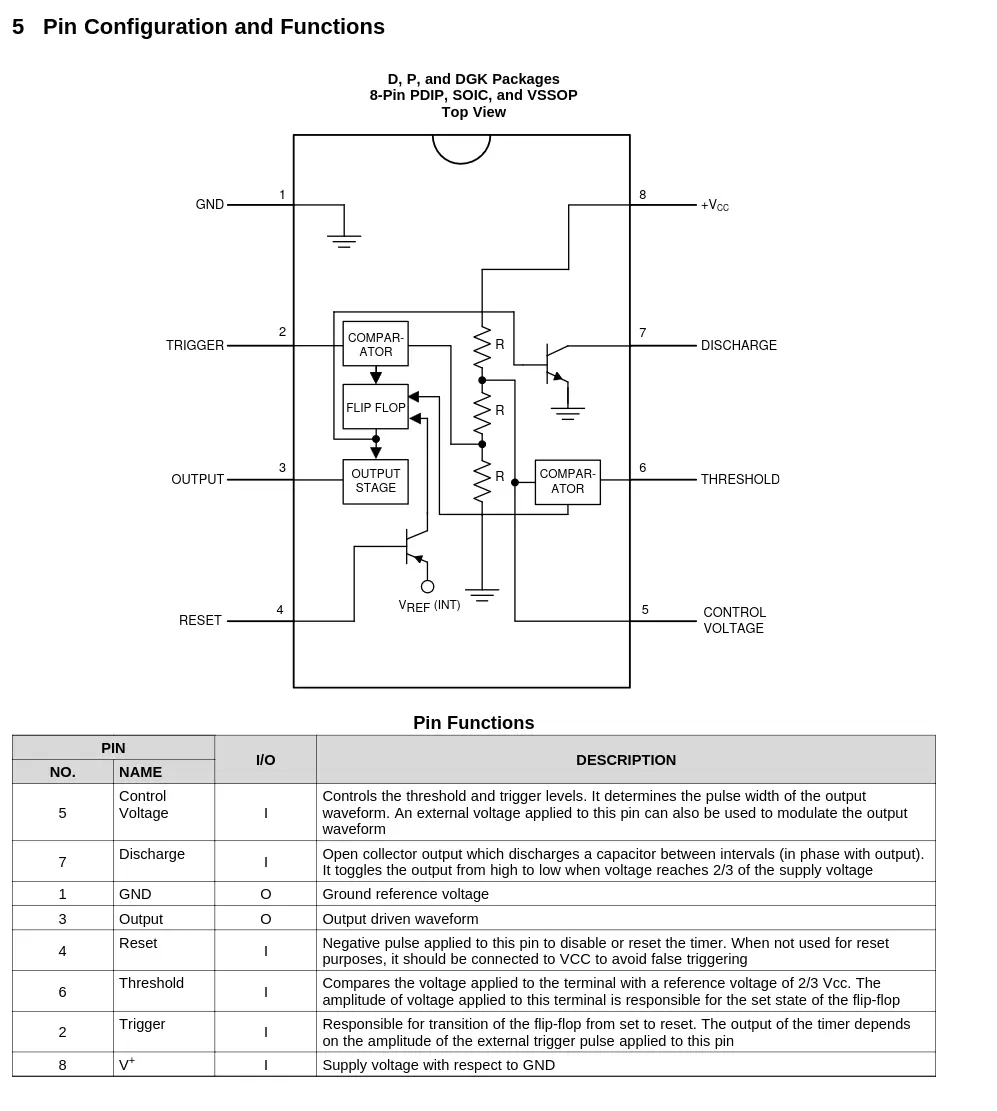 from TI LM555 datasheet
If you look at the datasheet above, you'll see the 555 only has 8 pins, and each one has a specific job. A few of them (ground and supply voltage) just power the chip, while the rest are what actually control its timing behavior. You don't need to memorize all of them right away, just know that trigger and threshold are the two pins that set your timing, and output is where your signal actually comes out.
Here's what each pin does in plain terms:
| Pin | Name | Function |
|---|---|---|
| 1 | Ground | Connects to the negative (0v) supply rail |
| 2 | Trigger | Starts the timing cycle when it's pulled below 1/3 of the supply voltage |
| 3 | Output | Where the 555's output signal (high or low) comes out |
| 4 | Reset | Forces the output low when pulled low, usually just tied to the supply so it's always "on" |
| 5 | Control Voltage | Lets you fine-tune the timing thresholds; usually left unconnected (sometimes with a small capacitor to ground) |
| 6 | Threshold | Ends the timing cycle when it's pulled above 2/3 of the supply voltage |
| 7 | Discharge | Provides a path to drain a timing capacitor, working alongside the threshold and trigger pins |
| 8 | Supply Voltage | Connects to the positive supply rail |
Here's a really cool video which I really like that explains the 555 timer and how it works internally.
Common Examples
The 555 can be wired up in a few different configurations, and which one you pick depends entirely on what you want it to do. Below are the three classic modes, all of which are worth trying out in Falstad before you build your own circuit.
Some common circuits made with a 555 timer are:
Astable Mode
It's output continously oscilates between high and low states and generats a square wave. This is used for generating clock pulses or generating tones.
Monostable Mode
When an external event pulls the trigger input low and output of the 555 transitions to a HIGH state for a specific timeframe before automatically turning low. This is used in things like delay timers.
Ideas
You could make a ton of things with a 555, here are some ideas:
- A Synth (you can actually do this in falstad)
- A Blinky!?
- PWM controller
- much more! google for more fun stuff